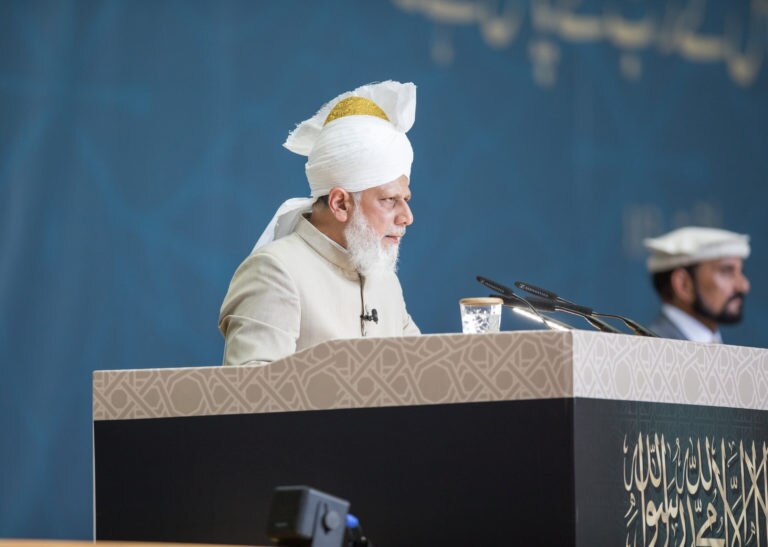
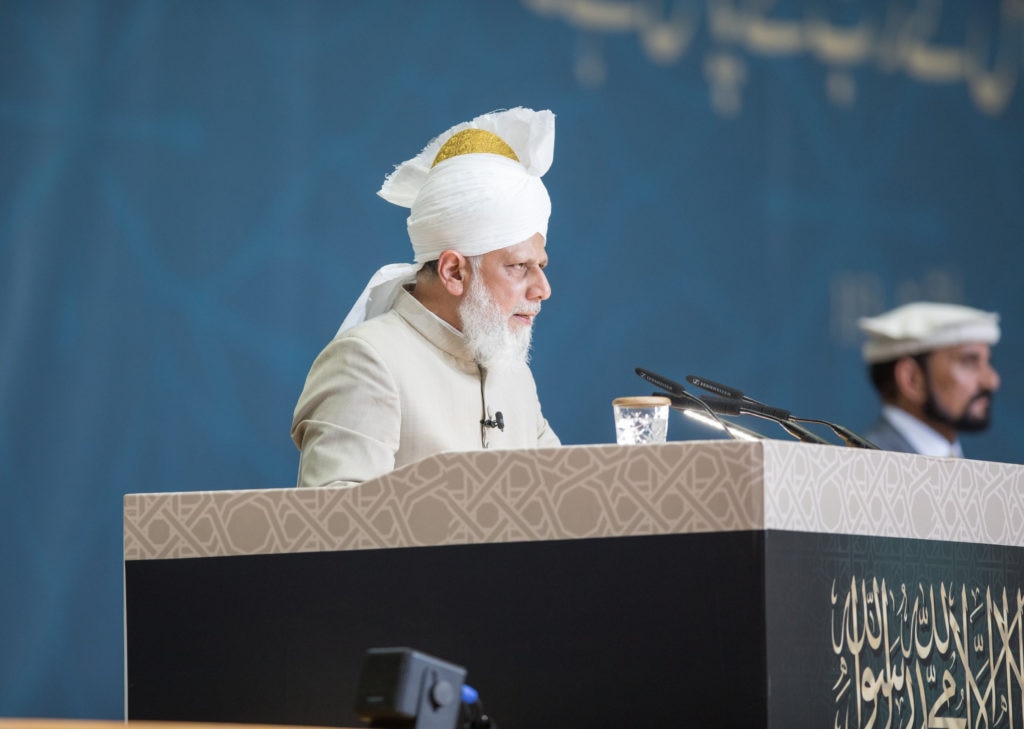
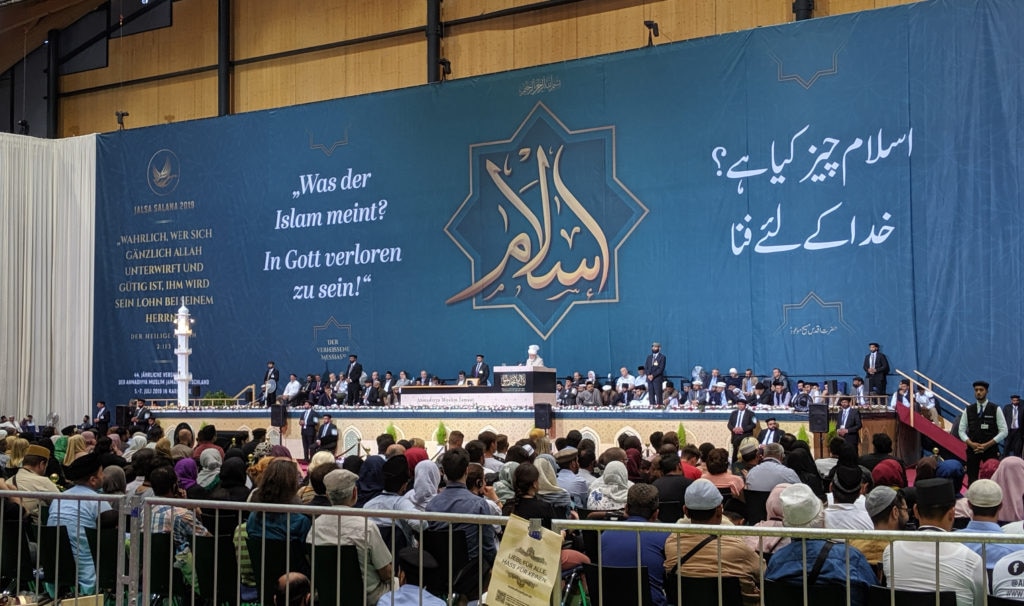
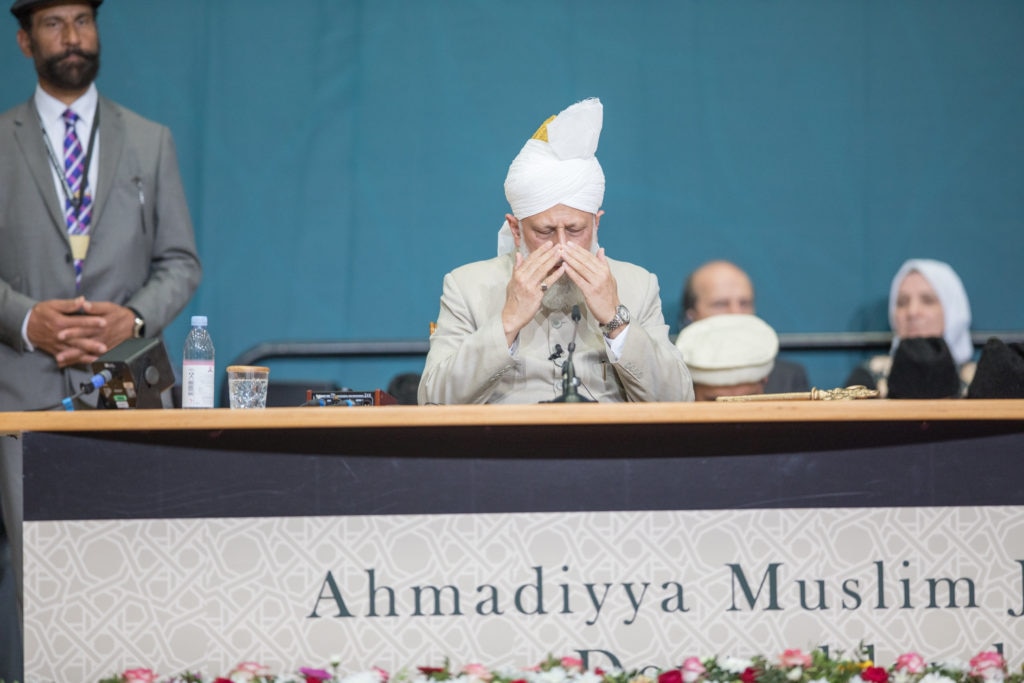
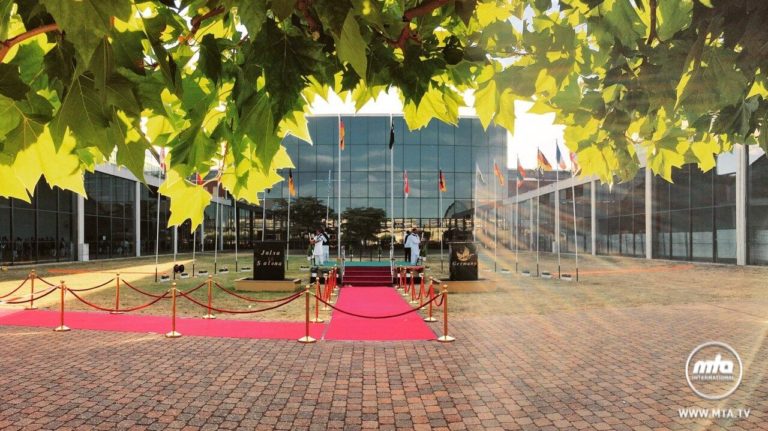
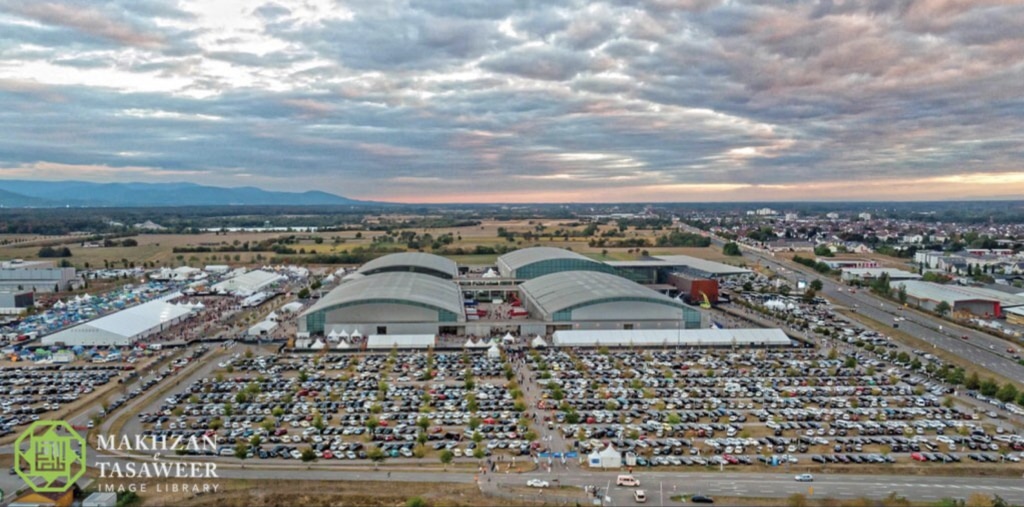
Karlsruhe, 6 July: Hazrat Khalifatul Masih Vaa delivered his second address today at a special session with non-Ahmadi guests attending Jalsa Salana Germany.
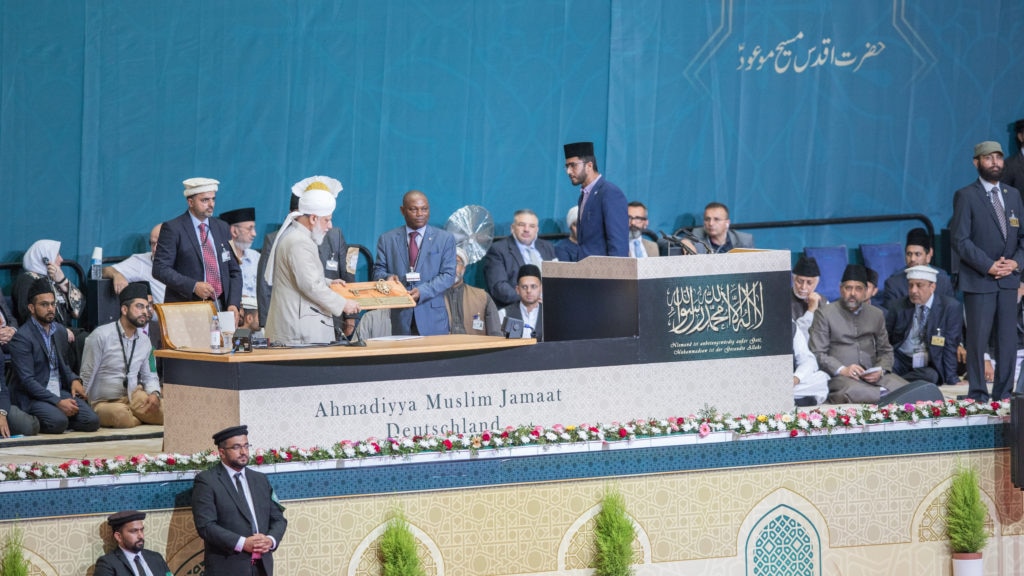
Before the opening session commenced, Urino Jose Botelho, representative of Sao Tome, presented Hazrat Amirul Momineenaa with a key to a new hospital on behalf of the President, Manuel Pinto da Costa. Mr Botelho thanked Huzooraa for the hard work carried out by Humanity First in Sao Tome whilst also inviting him to Sao Tome for the opening of the new hospital.
Courtesy of AMJ Germany
The recitation of the Holy Quran from Surah Ha Mim al-Sajdah, verses 34-36, initiated the formal session. Thereafter, Hazrat Amirul Momineenaa addressed the assembly.
After tashahud and ta’awauz, Huzooraa thanked the guests for attending the Jalsa after which he explained its purpose: the spiritual, moral and religious development of attendees.
The prophecy of the Holy Prophetsa was mentioned concerning the advent of the Messiah. Huzooraa explained the practice of God Almighty Who had always sent spiritual entities to revive religious communities. In the same light, the Promised Messiahas was sent by Allah as a reformer who revived and rejuvenated the true teachings of Islam whilst also bringing mankind back to its Creator.
After the brief introduction to the Jamaat, the current situation of the world was discussed. Humanity desires harmony, security and peace – world peace being the desire of every single person. However, the truth is that division and conflict have spread to all corners of the world; for example, currently, civil wars are rife. Tensions within states are present, immigration has caused a rift within countries and the world is now at a breaking point.
At an international level, nation states are fighting one another and unjust wars are taking place. Economic and trade wars have started to assert dominance. Huzooraa said “The world is being plagued by the blood-soaked stain of conventional warfare.”
Hazrat Amirul Momineenaa stressed the sad reality of the world ruining the future prospect for our children. The unimaginable threat of a war is at its brink. Huzooraa highlighted that powerful nations are asserting their influence in an unjust manner, trying to achieve their own aims.
Terrorist organisations and their political ideals were talked about whilst the dangers of the rise of the far-Right was also discussed. Mentioning “intolerant bigots”, Huzooraa said that they are disuniting society and causing disruption. It is therefore evident that though humanity has an innate desire for peace, the reality is quite the opposite.
Hazrat Khalifatul Masihaa said that he had been raising the voice against the situation of the world for a long time and now, other people were also raising such a voice.
Huzooraa mentioned a French ambassador to the United Nations Security Council who expressed his dismay at the condition of the world and the failure of the UN in various matters, saying “We are now in a new world disorder.”
Huzooraa indicated that powerful nations aim to establish a new world order, however even high ranking diplomats admit the reality is far from it; instead, we have a new world disorder.
The same mistake that took place in Syria cannot express itself with Iran again.
Reiterating the words of a professor who was a senior economist at the White House during the Clinton administration, it was voiced that a war between the US and China would be worse than the infamous Russo-US Cold War.
Huzooraa said, “My greatest fear lies in the potential of a nuclear war breaking out.” A war between the US and Iran would have an effect on the whole world, including Germany and other European nations. Therefore, Germany and other European nations must take practical steps to stop such a war.
Professor Taylor, an economist and academic, mentioned that the youth are not worried by the threat of a nuclear war, rather, climate change is seen as the greatest danger, something which worried him.
According to a recent survey, Germans are most worried about climate change. However, this is not the greatest risk; nuclear war is a far greater risk. Referring to various academics, it was highlighted that the nuclear threat the world is experiencing currently is the greatest danger.
Economic issues naturally came under discussion. The current economic structure based on a capitalist system has been widely accepted as weak and frail. Huzooraa said that economic fairness should underpin the world financial system.
The potentially devastating effect of Brexit on Germany was also mentioned.
Huzooraa presented a recent study in support of the economic benefits of immigration. To blame immigrants for all the problems of a country is greatly unjust when actually all nations are interdependent.
Huzooraa said that “instead of creating barriers and isolating ourselves” we should “work together for common good”; governments should strive for this. At the same time, it is the responsibility of immigrants to integrate.
With all of these points in mind, it can be deduced that the blame for the lack of peace in the world cannot be put upon Islam, rather there are geopolitical issues underlying these problems.
There is only one path that can lead us to salvation and deliver us from war and conflict – that is the path of God. Huzooraa said, “Peace does not lie in power or wealth, rather peace lies in the cradle of God Almighty.”
Allah’s mercy has always been expressed when the world has been on the brink of destruction through a reformer; for this era, it is the Promised Messiahas. This Messiahas told the world that Islam is a religion of peace and brotherhood, whilst also exhorting Muslims that they must fulfil the rights of God’s creation.
Echoing the Promised Messiahas, Huzooraa said to seek refuge under the shade of God Almighty to be safe from wars and conflict.
Drawing on the saying of the Promised Messiahas, Huzooraa said that if mankind did not recognise its Creator, then no nation would be safe.
Courtesy of AMJ Germany
At the end, Huzooraa prayed that we set a positive example for those who follow us so that our coming generations live in peace. Huzooraa prayed for the dark clouds of war and enmity to give way and be replaced by eternal blue skies of peace and prosperity in all parts of the world.
Huzooraa thanked the guests for taking the time out to attend the event.
Karlsruhe, 6 July: Hazrat Khalifatul Masih Vaa presided over the session at the ladies Jalsa Gah at 11:00 GMT, delivering an insightful address on the responsibilities of Ahmadi men and women in light of the Holy Quran.
The programme was initiated with the recitation of the Holy Quran – verses 12-15 of Surah al-Hujurat – with Urdu translation. A poem written by the Promised Messiahas was then recited, following which Huzooraa handed out awards to exemplarily academic achievers.
After tashahud, ta‘awuz and Surah al-Fatihah, Huzooraa recited verses from Surah al-Nahl that highlighted the equal reward for both women and men if they carry out good deeds.
Hazrat Amirul Momineenaa explained that the Holy Quran sets out separate responsibilities for men and women. One example is the offering of Salat in congregation that is compulsory upon men and not for women. Accordingly, Huzooraa explained that if women were to offer their prayers at home whilst also taking care of their home, then according to the Holy Prophetsa , they will attain the same blessing and reward as a man who offers his Salat in the mosque. Huzooraa said that Islam has stressed that each person, man and woman, will be granted reward according to their own intentions and responsibilities.
Huzooraa explained that Islam wants men and women to carry out deeds for the pleasure of Allah. He spoke of those who raise allegations against Islam saying that it does not deliver equal rights to women as compared to men. This verse of the Holy Quran presents the answer and nullifies their objection. Those who ponder over whether or not Islam grants women rights are not aware of the beautiful teachings of Islam.
Huzooraa exhorted that every woman and man in the Jamaat should remember that we must adopt the teachings of Islam whilst not being affected by those who are away from religion; we must prove that Ahmadis follow the truth. We must act upon the commandments of Allah; if we do this, then we will gain the pleasure of Allah.
Speaking of various events, Huzooraa stressed that no matter how many tarbiyati classes, Jalsas or events take place, they are useless unless good aspects are adopted forever within our lives; temporary actions are not enough. Huzooraa reminded the congregation that our knowledge and insight is void unless we act upon the instructions of Allah the Almighty.
Discussing the passage of the Holy Quran that states “And give glad tidings to the believers”, Huzooraa said that both men and women are addressed and the first trait mentioned by Allah after this is that “they seek forgiveness”. Regarding seeking forgiveness, Huzooraa presented a saying of the Promised Messiahas in which he said that true forgiveness is such that if one is even thrown into a fire, they will not commit sin.
Istighfar [seeking forgiveness] is essential to protect oneself from modern day ills that are encompassing society today. During the address, it was explained that people are so engrossed in the world today that their hearts have become perverse and rust has developed whilst the light of religion has been lost. If one desires to be protected from this, then believers must continuously occupy themselves in istighfar and make a special effort; this cannot happen without the grace of Allah.
Huzooraa explained that after speaking of seeking forgiveness, Allah points towards the need for worship; the most important being Salat.
Women must pay special attention in establishing the habit of offering Salat within their children. Huzooraa said that fathers also have a strong effect upon their children, especially boys, therefore fathers also have a responsibility.
Mothers who themselves offer prayers and exert effort in the righteous upbringing of their children will gain the blessings of Allah. Huzooraa said that some children, due to the example of their fathers, are ruined. However, it is observed that through the tarbiyat and prayers of mothers, they revert back. Thus mothers have a huge responsibility for the righteous upbringing of their daughters.
The next trait of believers Huzooraa mentioned was that “they praise Allah”. Huzooraa said that when one is able to exercise true praise, they realise that all praise belongs to Allah. Some young girls start thinking that even though they prayed, worked hard and praised Allah, they did not achieve what they wanted; they then begin to divert away from Allah. Huzooraa said that if we look towards the Hereafter and realise that this life is temporary, then we will always praise Allah and never give up. No matter what the condition, a true believer praises Allah.
Hazrat Amirul Momineenaa reminded the audience that one should always keep in mind that every blessing is due to Allah and is not the result of some personal quality. Steadfastness and patience is essential for a believer; Allah always blesses such a believer, he reminded.
Referring to the Holy Quran, Huzooraa said that another quality of a believer is that they travel for the sake of Allah. Pointing towards the migration of Ahmadis towards Western countries, Hazrat Khalifatul Masihaa reminded listeners that they had travelled for the sake of Allah and this requires us to walk in accordance with the commandments of Allah.
If women self-reflect, they will realise that all the material wealth they possess is a reward from Allah because they travelled from Pakistan to these countries for His sake. Talking about the education of women in particular, Huzooraa highlighted that it would not have been possible to be educated to this level if they were still in Pakistan. Therefore, due to these blessings, Ahmadis should always be attached to Allah and not be influenced by the so-called freedom of the West.
Referring to the kindness of Western governments, Huzooraa said that even though the influx of Ahmadis is a burden upon the government, however they still keep Ahmadis here due to the good actions of Ahmadis; this is another blessings of Allah.
Talking about taking social welfare, Huzooraa advised Ahmadis to find work and not become a burden upon the government – one should give rather than take.
If we want the grace of Allah in this world and the next, then within ourselves and our children we must ensure that we have immigrated for the sake of Allah and we should never be unfaithful to Him.
Referring to the Holy Quran again, Huzooraa spoke of the trait of worship within a true believer. True and effective prostrations are those that draw one to a close relation with Allah.
Believers are also those who exhort towards good and shun bad. If Ahmadi women and men act upon this teaching of the Holy Quran, then we will develop a peaceful and spiritual atmosphere. Huzooraa strongly expressed that if men do not act righteously and present a good example, then they will be at error. And if good examples are presented within parents, then children will be protected from the ills of Western society; this is the responsibility of both parents.
If every household purposefully takes action to save themselves from the ills of society, it is only then that we can be protected. Huzooraa said that society is trying to destroy religion with full force; this can be counteracted only if mothers and fathers acquaint themselves with knowledge and teach their children. Shyness cannot be adopted with current day issues and children should be told of the ills of society and its Islamic solution.
Huzooraa said that despite this, Ahmadis should be active members of society and serve society to the best of their ability. The rights of mankind must be fulfilled.
An Ahmadi mother’s responsibility is that they inculcate the teachings of Islam within their children and pray for them. This responsibility is upon men as well.
Hazrat Khalifatul Masih Vaa reminded the audience towards the Bai’at we have taken of the Promised Messiahas, and thus we should act in accordance with his teachings.
Reading out an extract of the Promised Messiahas, Huzooraa reminded Ahmadis not to be wholly engrossed in the world alone, rather one should aim to establish the true essence of Islam within themselves; praying before Allah, seeking His grace and guidance.
Underlining the teachings of the Promised Messiahas, Huzooraa said that one must try to gain the grace of Allah and seek His power and protection.
Huzooraa concluded the address by praying that we are all able follow the teachings of Allah, His Prophetsa and the Promised Messiahas. He prayed that may we stay protected from the ills of the world and fulfill our pledge of allegiance to the Promised Messiahas.
Various poems in many languages were recited before Huzooraa by lajna from various nationalities, after which Huzooraa proceeded for the Zuhr and Asr prayer.
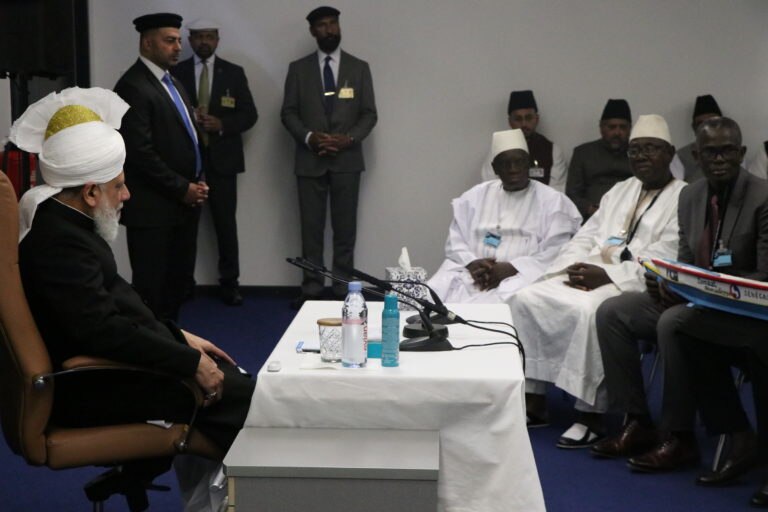
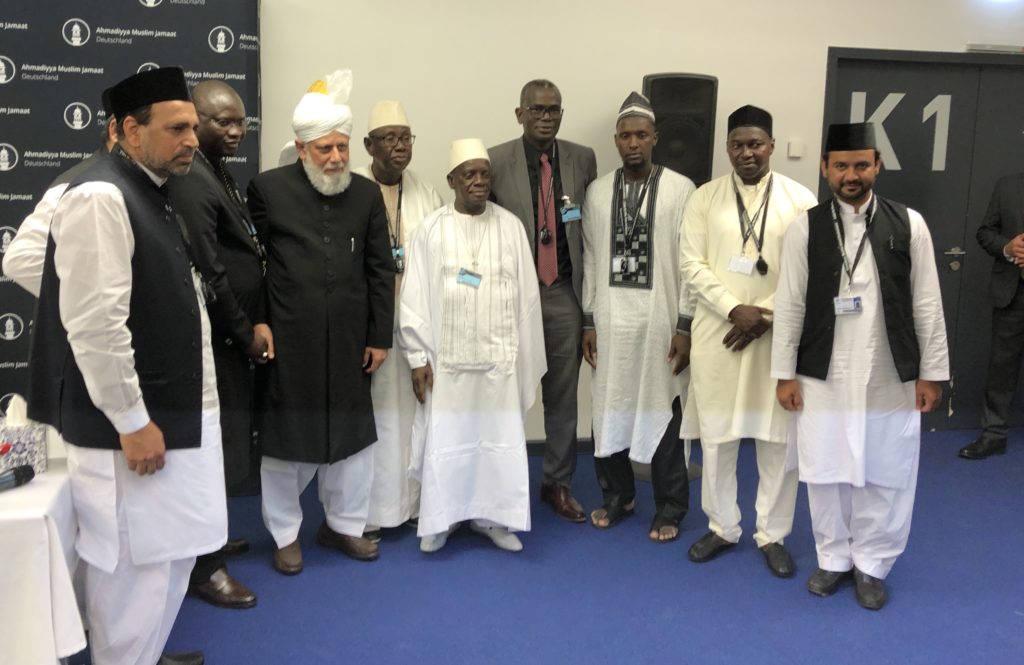
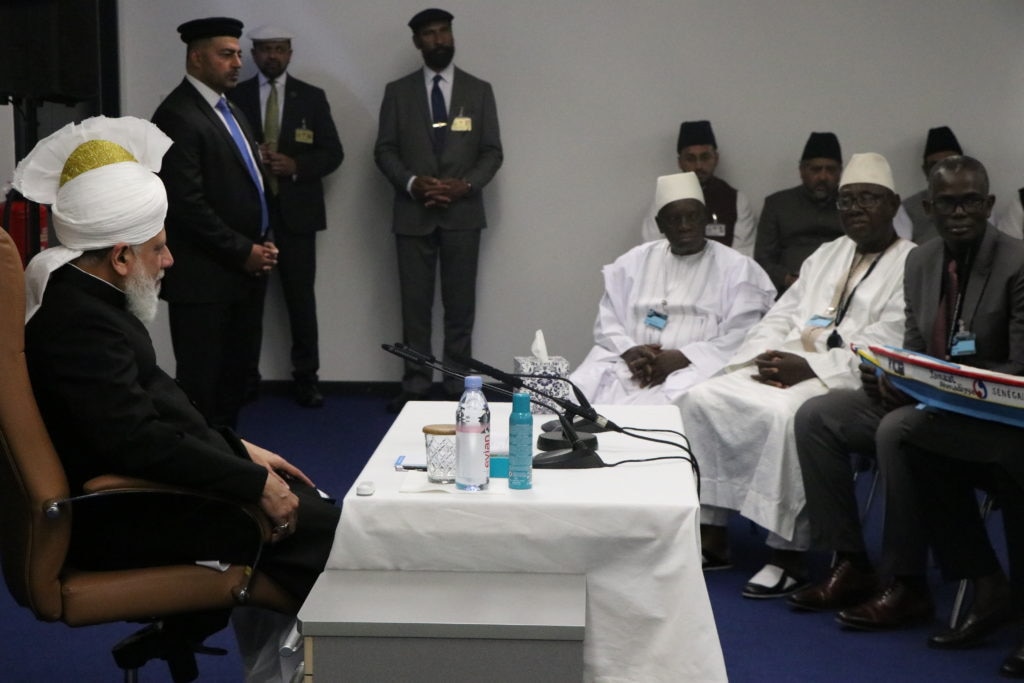
Karlsruhe, 5 July: Three foreign delegations today got the opportunity to have audience with Huzooraa. The first delegation to meet Hazrat Khalifatul Masihaa was from Senegal; government officials were accompanied by the missionary of Senegal and their local mualims.
One of the government officials who supervises hospitals in a region of Senegal expressed his gratitude to Huzooraa for the Jamaat’s contribution in providing healthcare facilities in their country.
The two government officials expressed that they were overawed to listen to Huzoor’s Friday Sermon and that it had a deep effect on them. They expressed their desire to one day join the Ahmadiyya Jamaat. Huzooraa advised them that it is only purity of heart that leads to true faith.
One of the guests said that a region had discovered petroleum fields. Huzooraa said that he had been informing world leaders of such circumstances before and reminded that everyone has a right over such resources and not just a specific circle of society.
Many of the guests said that they agreed with everything Huzooraa had said earlier in his Friday Sermon.
Photo courtesy of The Review of Religions
Another guest, an imam of a large mosque in the country, expressed his gratitude for the invitation to Jalsa Salana, after which he mentioned that he would like to visit Huzooraa in the UK. Huzooraa said that he would be welcome at any time to stay as the Jamaat’s guest.
Towards the end, Huzooraa said, “We never withdraw our hand of friendship. We hope that you too will not.”
Both the gentlemen said, in a very affirmative tone, that they too would not withdraw their hand of friendship.
Huzooraa prayed for their wellbeing after which they requested a photograph with Huzoor.
The next delegation to see Hazrat Khalifatul Masih Vaa this evening was from Mayotte. After a brief introduction to the guests by Usama Joya Sahib, Missionary of Mayotte, one of the guests, who is a lawyer, said that he had the desire to build a library in collaboration with the Jamaat. Huzooraa explained that by looking at the large halls and great hospitality, he should not think that we are a rich community as we are not. All this becomes possible through the funding of members of the Jamaat and Allah’s grace.
The gentleman expressed his desire to help regardless of funds, to which Huzooraa said that he was more than welcome to help, but he should be aware that the orthodox Muslims of the area would not take kindly to his relationship with our Jamaat, even though we would of course appreciate the help. The gentleman was adamant to be of any help whatever the reaction.
Another gentleman who is the first in his family to accept Islam Ahmadiyyat said that he had to go through many hardships after accepting Ahmadiyyat, but at the same time, he had witnessed Allah’s blessings in abundance; he got married, his economic condition improved, he was blessed with a child and all this, he said, was only to mention a few.
The next and last delegation to have an audience with Huzooraa this evening was from Lithuania. This was a large group, but many of them got the opportunity to speak to Hazrat Khalifatul Masihaa on various matters and seek guidance.
A member of the delegation asked Huzooraa how he had felt when he became Khalifa. Huzoor replied that it was as if a heavy burden had fallen upon his shoulders. Another member – an author – expressed his desire to write about the institution of Jalsa Salana. Huzooraa advised that it would be better that he wrote about the peaceful teachings of Islam.
A Christian lady mentioned that she was aware of the beliefs of many religions and was particularly interested in the purification of the soul. She wanted to know Huzoor’s views on the topic. Huzooraa explained that every religion has its own concepts in this regard, but we should all pray that Allah keeps us on the right path. Once one is conscious that God watches every deed of ours, one tends to lead their life in the best possible way. This automatically leads to the purification of the soul.
Another gentleman, from Azerbaijan, requested for prayers and enquired when Huzooraa intended to visit their land. Huzoor said that they should pray that this becomes possible soon and also advised that they should plan for such an event and formally send out an invitation so that plans could be made accordingly. The gentleman happily agreed to do whatever was in his capacity.
Another delegate told Huzooraa that he worked for the state education department. He mentioned that they worked on schools working in collaboration within the country and was willing to extend this countrywide scheme to an international scale. Huzooraa instructed the missionary to look into the matter and discuss the feasibility with the Markaz.
A lady was eager to know how Huzooraa finds time to fulfil his personal interests and hobbies. Huzooraa replied, “My hobby is the work that I do for the Jamaat.”
A young man enquired why Islam seemed more attractive than Christianity. Huzooraa explained that all prophets were from Allah the Almighty and the Holy Prophet Muhammadsa was also from Allah. It was through him that the last book of God, the Holy Quran, was revealed for the welfare of mankind. Huzooraa said that since there is no coercion in religion, anyone is welcome to accept Islam, but whosoever does not, it is a matter of their own choice.
Some members wanted to know about the basic teachings of Islam Ahmadiyyat. Huzooraa very lovingly stated briefly the magnificent teachings in the most appealing manner.
After each mulaqat, Huzooraa graciously permitted photographs with him.
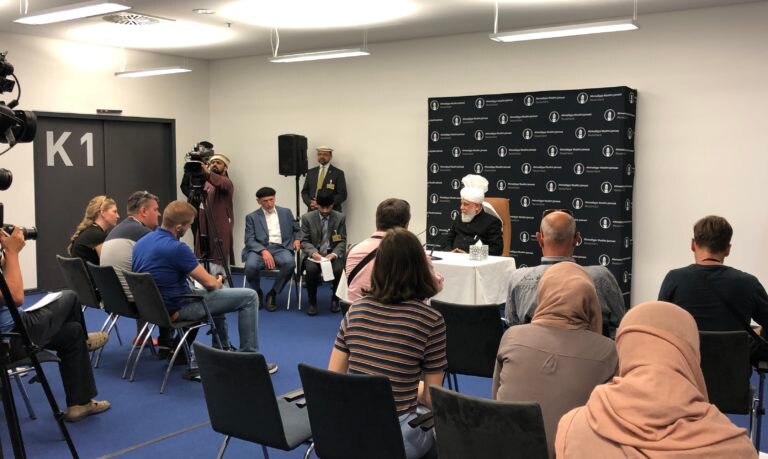
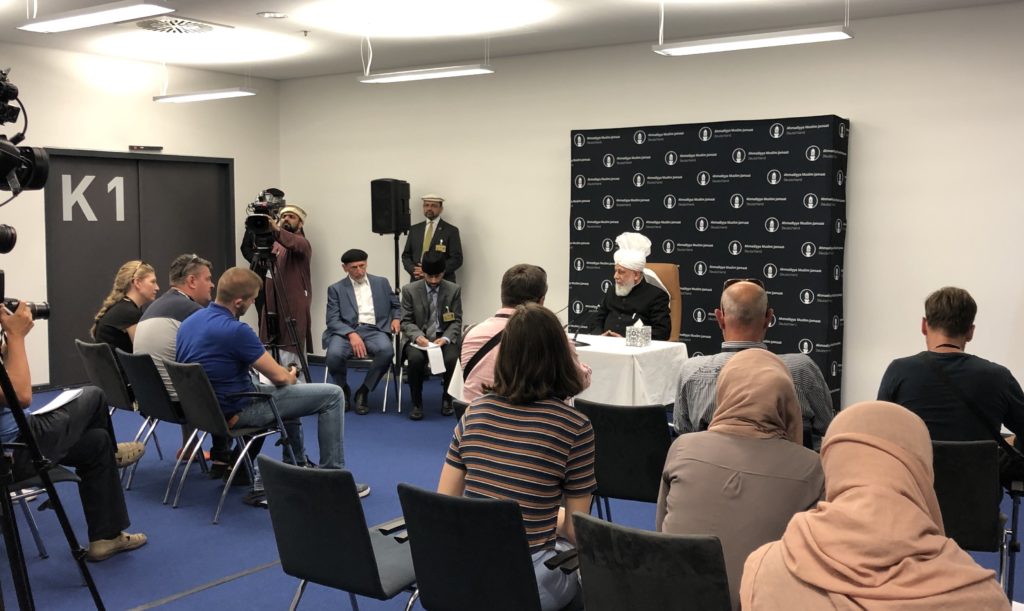
Karlsruhe, 5 July: Immediately after the Jumuah prayer, Hazrat Amirul Momineenaa made his way for a meeting with press representatives who had questions to ask on social issues related to Islam.
The first question asked was with regard to Huzoor’saa message at Jalsa Salana. Huzooraa explained that the purpose behind the event is for the spiritual level of members of the community to improve and for them to fulfil their responsibilities towards their Creator and fellow beings.
Another press representative asked why Islamophobia existed. Huzooraa replied that we should understand the real reason behind this hostility towards Islam. Huzooraa explained that there is a very small percentage who feel threatened by Islam. There are two groups: one who, in the name of Islam create unrest and violence, while there is the other group who, again in the name of Islam, promotes peace and love. Disturbances by extremists are the fault of the very extremists. If one cannot find anything wrong with the teachings of Islam, then there can be no Islamophobia.
Huzooraa then advised to look at countries such as USA where thousands of people are killed too frequently. Huzooraa said that American civilians are responsible for those instances and asked why such people are not considered a similar sort of threat? Thus, we should not brand these actions in the name of Islam, even if they are committed in the name of Islam.
After that, a brief question was posed to Huzooraa about his message to the world through this Jalsa. Huzooraa said that he had already alluded to this in his Friday Sermon: we should discharge our responsibilities to God and our fellow beings and live peaceably across the world.
A question was then asked in Bosnian, which was translated for Huzooraa; Why do Europeans feel threatened and insecure by immigrants. Huzooraa said that such a question should actually be asked to those who feel threatened. If Europeans feel threatened, then, Huzooraa explained, it is because of the growth of certain communities which results in locals having many apprehensions. Huzooraa went on to clarify that religion never spreads through immigration. If values are kept in tact, then there should be no threat felt by anyone.
A lady asked about the role of women in the community, to which Huzooraa responded that we must, as Muslims, follow the teachings of Islam, the Holy Book and the sayings of the Prophetsa. If we do not, then this would be deviating from the actual purpose of our religion. It is an established fact that only a century ago, rights were not given to women in the West. It was Islam that offered rights for divorce, the freedom in choosing a life partner and other such privileges over a thousand years ago.
Huzooraa added that the following day, the ladies would be holding their session in which ladies would offer speeches and that he would also be addressing them in their hall. Their side of Jalsa Salana has an equal amount of effort and preparation behind it and same facilities and amenities. The journalist who asked this question was accompanied by a German Ahmadi lady, Khola Hübsch Sahiba. Huzooraa told the journalist that her host speaks much better than many of the men of the community.
Huzooraa added at the end, “My philosophy is, if women work outside the shade of men, they flourish better.”
The land
of Germany, yet again, has been blessed with the arrival of Hazrat Amirul
Momineen, Khalifatul Masih Vaa for the 44th Jalsa Salana
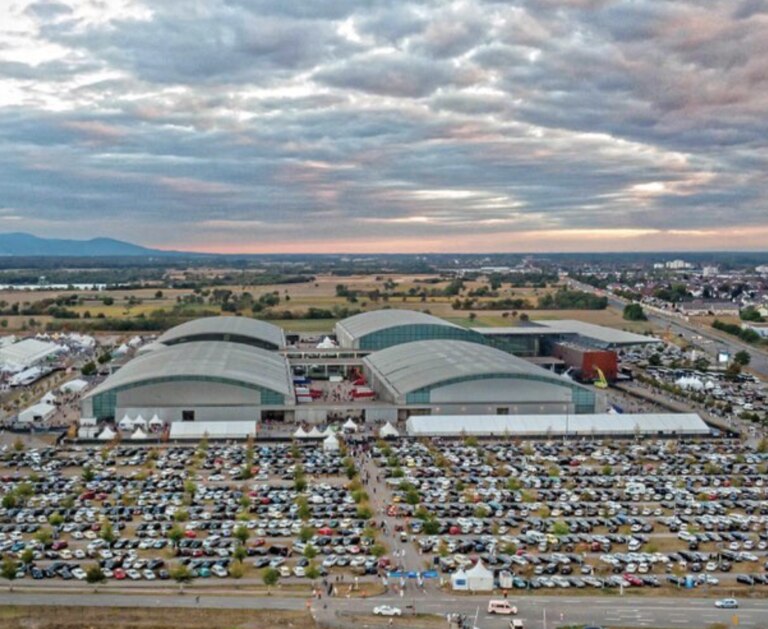
Germany to be held in Karlsruhe from 5-7 July. Huzooraa arrived at
Baitus Subuh, Frankfurt on Tuesday, 2 July at around 22:30 local time.
Extensive planning and preparations had
taken place to prepare the Jalsa site for Huzoor’s inspection and the formal
inauguration of Jalsa duties. Huzooraa addressed volunteers at the
inspection on Thursday, 4 July and reminded them of their responsibilities with
regard to taking special care of the guests of the Promised Messiahas.
Today, Huzooraa initiated the
Jalsa with the flag hoisting ceremony prior to his Friday Sermon.
At present, thousands of guests from a
plethora of nationalities and countries are populating the magnanimous site for
the three-day spiritual assembly where they will have the opportunity to offer
daily prayers behind Hazrat Khalifatul Masihaa whilst also listening
to his insightful addresses.
The speeches delivered by Huzooraa
will be broadcast live to millions across the globe through MTA International;
Saturday will see two key-note addresses by Huzoor. The first from the ladies’
Jalsa Gah at 11:00 GMT.
Thereafter, in the afternoon at 14:30 GMT,
Hazrat Amirul Momineenaa shall deliver an address to non-Ahmadi
guests attending Jalsa Salana.
Sunday’s highlight encapsulates the Bai‘at
ceremony with Hazrat Khalifatul Masih Vaa at 13:45 GMT followed by
the concluding speech to the convention. Also, on the agenda is an awards
ceremony during which Huzooraa will award students who have shown
exemplary academic performance.
Guests who have flocked to Germany are
reaping blessings from Huzoor’s presence whilst having the opportunity to pray
behind Hazrat Amirul Momineenaa; to offer Tahajud prayer, listen to
Duroos and meet fellow Ahmadi brothers and sisters from close and afar.
A number of speeches covering a broad
spectrum of topics will be delivered throughout the three days by various
speakers; some themes include the humility of the Holy Prophetsa,
the advent of the Promised Messiahas, the Holy Quran, the blessed
life of Hazrat Maulana Ghulam Rasul Rajekira, Islam in the digital
age, Salat, the remembrance of Allah, the pledge of Bai‘at and the upbringing
of children.
A separate session throughout the Jalsa
Salana is taking place at the ladies’ Jalsa Gah where several speeches and
sittings will occur simultaneous to the men’s Jalsa Gah. However, all shall
listen to Huzoor’s addresses live at the same time.
As always, guests have arrived for this
spiritual gathering from a host of countries including Pakistan, India,
Bangladesh, African countries, America, Canada, the United Kingdom, Middle
Eastern countries, Russia, Georgia, France, Finland, Belgium, Czech Republic,
Romania, Bulgaria, Iceland and even south American countries to mention but a
handful.
As the Promised Messiahas expressed
at the very first Jalsa Salana in 1891 in Qadian, the purpose of the Jalsa will
be spiritual reformation; a teaching Huzooraa has continuously
stressed.
The presence of Huzooraa at
Karlsruhe is an extremely special opportunity for those present to fulfil the
spiritual purpose of the Jalsa as described by the Promised Messiahas
The
three-day proceedings will be televised and streamed live by MTA International.
Readers are urged to tune in and benefit from this blessed occasion.
The Promised Messiahas stated in his work Tadhkiratu Shahadatain (The Narrative of Two Martyrdoms)
“The Christian faith is losing ground
daily in the field of reasoning and commonsense and great scholars are
renouncing their old beliefs. Even the emperor of Germany has talked of
relinquishing his faith. This proves that it is God Almighty’s will that the
Christian faith be obliterated from the face of the earth through rational
arguments.” (Tadhkiratu Shahadatain, p. 32)
Hazrat Mirza Ghulam Ahmad, the Promised
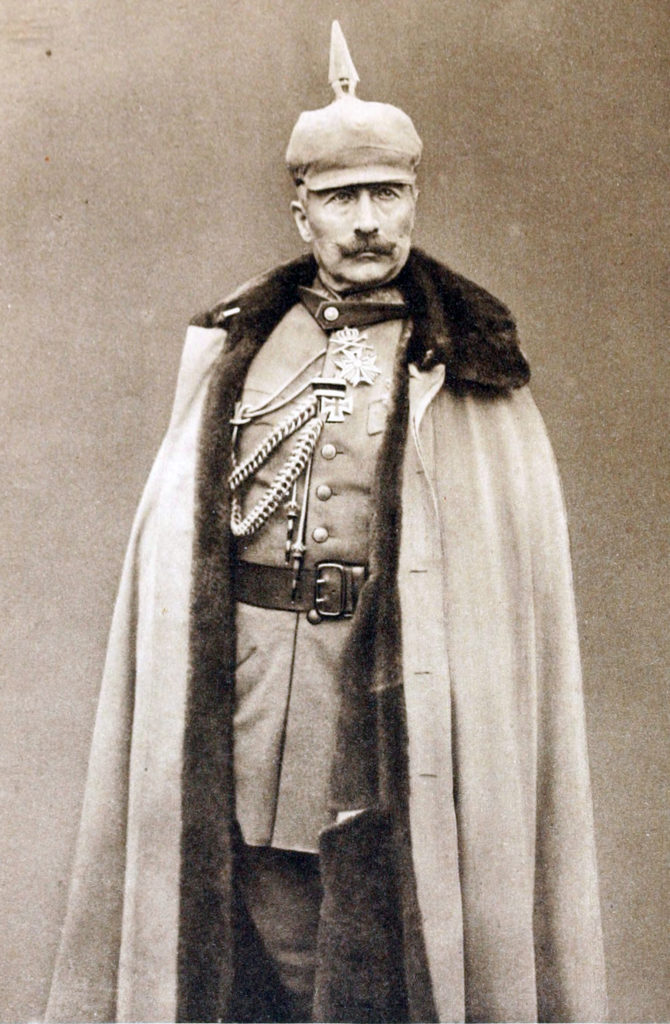
Messiahas wrote this book in 1903. The German emperor – or Kaiser –
at that time was Wilhelm II.
Having come across this passage of the
Promised Messiahas, we decided to find out where and how this change
of belief had come about in the heart of Kaiser Wilhelm II. The story is long
and windy, but let’s take a quick look at it.
At the junction of the 19th and
20th centuries, many European monarchs were from the progeny or
greater family of Queen Victoria. Wilhelm II was her maternal grandson and thus
a third-cousin of Tsar Nicholas II of Russia. Both had joined hands against
another cousin who happened to be the king of England.
In the high noon of colonisation, Russia,
Germany (or Prussia) and England were busy taking possessions of different
lands in Asia. An alliance with the Ottomans was much sought after as it could
possibly make a great deal of difference.
Wilhelm II visited the Ottoman Sultan on a
number of occasions. One such occasion was in October 1898 when he was guest of
Sultan Abdel Hamid and stayed in Constantinople for quite some time.
He remained constantly in touch with his
cousin Tsar Nicholas II through letters. These letters were later obtained from
the Government Archives in Petrograd in Russia by Isaac Don Levine – staff
correspondent to the Chicago Daily News – who brought their copies over to
London.
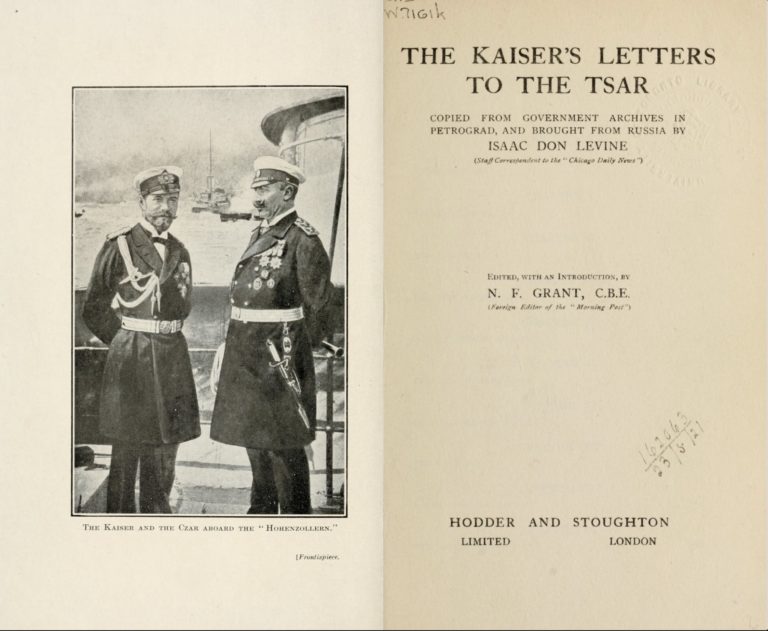
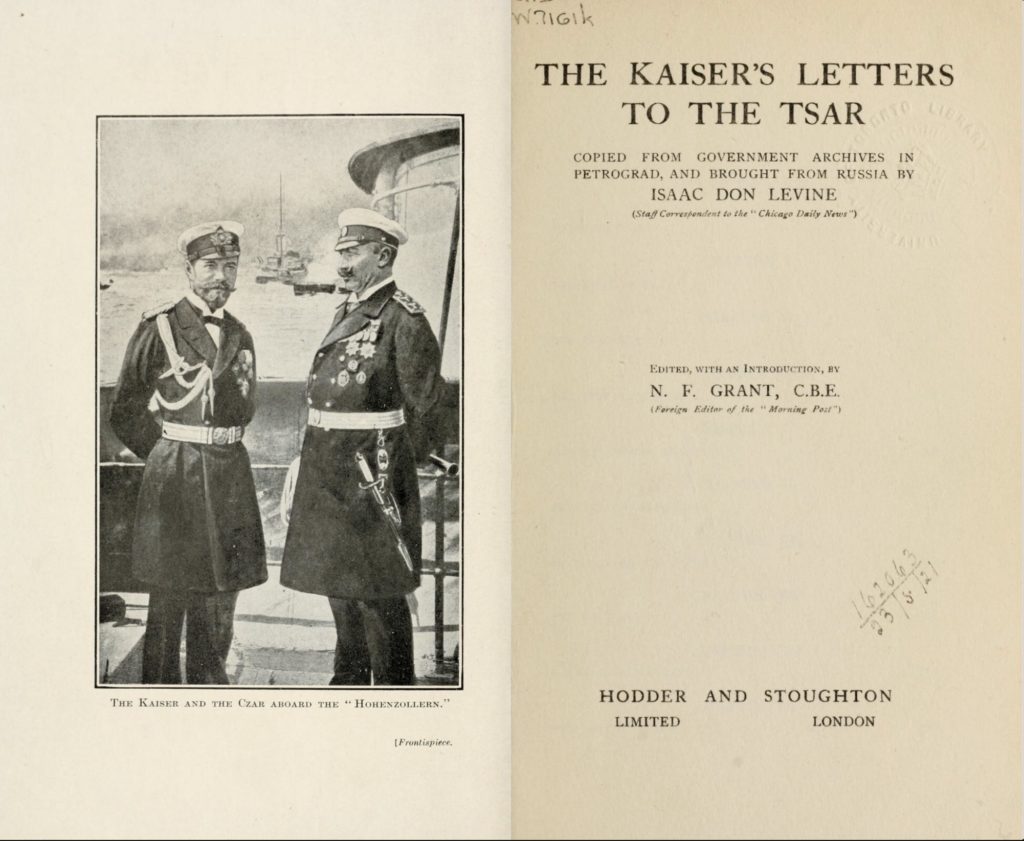
Later compiled in book form by NF Grant,
the book is titled The Kaiser’s Letters to the Tsar and was first
published by Hodder and Stoughton, London in 1920.
A letter dated 9 November 1898 is of
particular interest as it reveals the changing heart of the emperor. We quote
here some passages from the letter:
“The manifold and different confessions
and sects of our Common Christian faith have done too much in the way of
churchbuilding, the erection of monasteries, chapels, etc., on so called
‘Traditional Holy Places.’ Which has led to a sort of concurrence of race for
the highest towers or biggest churches, which do not at all harmonise with the
sites they are erected on. In fact one could call it an exhibition of
Church-models! This has also affected the clergies of the different churches,
who have a pleasure in intrigues and political designs fostering hatred instead
of love, and leading to free fights and battles in the churches instead of
Psalms and friendly intercourse. But what is worst still, they have created a
worship of stones and wood, forbidden in the 2nd of the X
commandments, instead of Divinity itself…
“Very naturally this – I beg your pardon –
Fetish adoration has created a supreme contempt for the Christians with the
Moslems.
“My personal feeling in leaving the holy
city was that I felt profoundly ashamed before the Moslems and that if I had
come there without any Religion at all, I certainly would have turned
Mahommetan!”
We now look at another letter written by
Kaiser Wilhelm II. This letter is recorded in a book titled The Kaiser’s
Memoirs: Wilhelm II, Emperor of Germany 1888-1918. The book was published
by Harper & Brothers Publishers, London, in 1922. The letter is addressed
to Friedrich von Hollman – a close accomplice and confidant – in a letter dated
15 February 1903. Quoted below are passages from this letter:
“It is self-evident that the Old Testament
contains a large number of parts which are of purely human-historical character
and not ‘God’s revealed Word’. These are purely historical descriptions of
events of all sorts, which occur in the life of the people of Israel in the
domain of politics, religion, morals, and spiritual life…
“As far as I am concerned, I am led by the
above to the following conclusion:
I believe in one only God.
We men need, in order to
teach Him, a Form, especially for our children.
This Form has been, up
to now, the Old Testament, as we now know it. This Form will be
essentially changed by research, inscriptions, and excavations; but that will
cause no harm, not will the fact that, thereby, much of the halo of the Chosen
People will disappear, cause any harm. The kernel and content remain always the
same: God and His influence.
“Religion was never a result of science,
but something flowing from the heart and being of man, through his relations
with God.”
The letter above was written by the Kaiser
in February 1903. The book Tadhkiratu Shahadatain was written by the
Promised Messiahas in October 1903.
While the above correspondence proves the
claim of the Promised Messiahas about the beliefs of a European emperor
to be true, it also proves how keenly the Promised Messiahas stayed
informed about what went on in the world.
John Lewis-Stempel, writing for The
Express, London stated that “the Kaiser’s embrace of Islam began with an
1889 visit to Turkey … A later visit to Jerusalem, then under the auspices of
the same flattering Sultan, left the impressionable Kaiser declaring that had
he arrived agnostic, ‘I certainly would have turned Mahometan!’
“Soon the Kaiser was styling himself
‘Hajji Wilhelm’, the protector of Muslims”. (The Express, 12 October
2014)
Wolfgang G Schwanitz – a German-American
historian of the Middle East – states in his work Die Dutschen und der Islam
that “Iranians still tell stories of ‘Hajji Wilhelm Muhammad’, who supposedly
converted to Islam”.
We know that he did not convert to Islam,
but from the historical evidences quoted above, we find that he had moved away
from Christianity and closer to Islam as the Promised Messiahas had
very rightly stated.
We hope and pray that the German nation soon sees the true light of Islam. The Ahmadiyya Muslim Jamaat waits with open arms to embrace them.
The message of the Promised Messiahas
had spread across the globe within his lifetime. A hand of special divine
succour and heavenly assistance can be seen working behind him.
The
teachings and message of the Promised Messiahas not only influenced
men but countless pious women accepted him as well. Moreover, a number of women
surpassed their husbands in embracing Islam Ahmadiyyat, for instance the mother
of Chaudhry Sir Zafarullah Khan Sahib. We find that in the year 1908, Professor
Clemant Wragge came to meet the Promised Messiahas along with his
wife and she too had the opportunity to ask questions.
Likewise,
Hazrat Mufti Muhammad Sadiq Sahib writes in his book Zikr-e-Habib [a recollection
of his memories]:
“Around
the year 1902, there was a lady in America by the name of Miss Rose … I started corresponding with her for the
purpose of tabligh. When we would receive her letters, I used to translate and
read them out before the Promised Messiahas and she became known by
the name of Miss Gulabo [rose in Urdu] in our gatherings. Once, it so
happened that Miss Gulabo placed petals of flowers in her letter. Seeing
them, Huzooras instructed to preserve those flowers as they [in a
way] fulfilled the prophecy:
يَاْتِيْكَ مِنْ كُلِّ فَجٍّ
عَمِيْقٍ
[They
will come to you by every distant track]. Those flowers are safe with me to
date.” (Zikr e Habib, pp. 98-99)
In relation to the Jalsa Salana of
Germany, readers of Al Hakam are presented a similar kind of letter
below, which was sent from Germany and carries extreme passion.
A look at religions and the propagation of
Islam – Letters from abroad
Al Badr, 14
March 1907
In a
recent mail from overseas, a lady by the name of Mrs Caroline’s letter has been
received from Pasing, Germany [a district in the city of Munich and part of the
borough of Pasing-Obermenzing], which has been sent to be presented before the
Promised Messiahas. It shows that the message of Ahmadiyyat has
reached these countries as well.
The revered lady says:
“I had been searching for your address
from several months so that I may write to you. Finally, I have met the person
now who has given me your address (the envelope carries the address, ‘Location:
Qadian; Region: Kashmir; Country: Hindustan’).
“I request you to pardon my expression of
writing you a letter, but it has been conveyed that you are God’s noble prophet
and an embodiment of the Promised Messiah. I am an ardent lover of the Messiah.
I have a keen interest in the issues of Hindustan as a whole and the matters of
faith in particular. I am deeply aggrieved when I hear the news of famine,
disease and earthquakes in Hindustan. I am also regretful of the fact that the
beautiful country of holy saints is laden with idolatry.
“I express my gratitude for the extreme
passion that you possess for Jesus, our Lord and emancipator. I will be greatly
pleased if you may pen a few lines of your sayings for me. I am a German by
birth and my husband was an Englishman. Though you are the rightful predecessor
of great luminous nations of ancient Hindustan, I believe that you understand
English.
“Please
send me a photograph of yourself if at all possible. Can I serve you some way
in this part of the world? Rest assured, dear Mirza, that I am your sincere
associate. Mrs Caroline.”
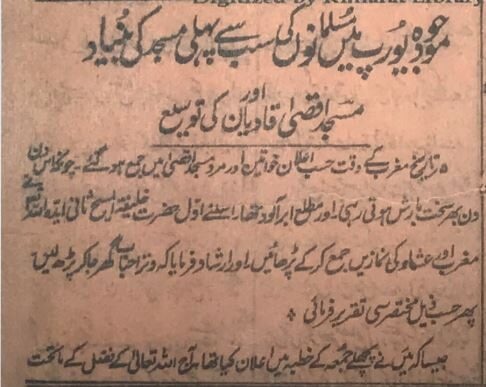
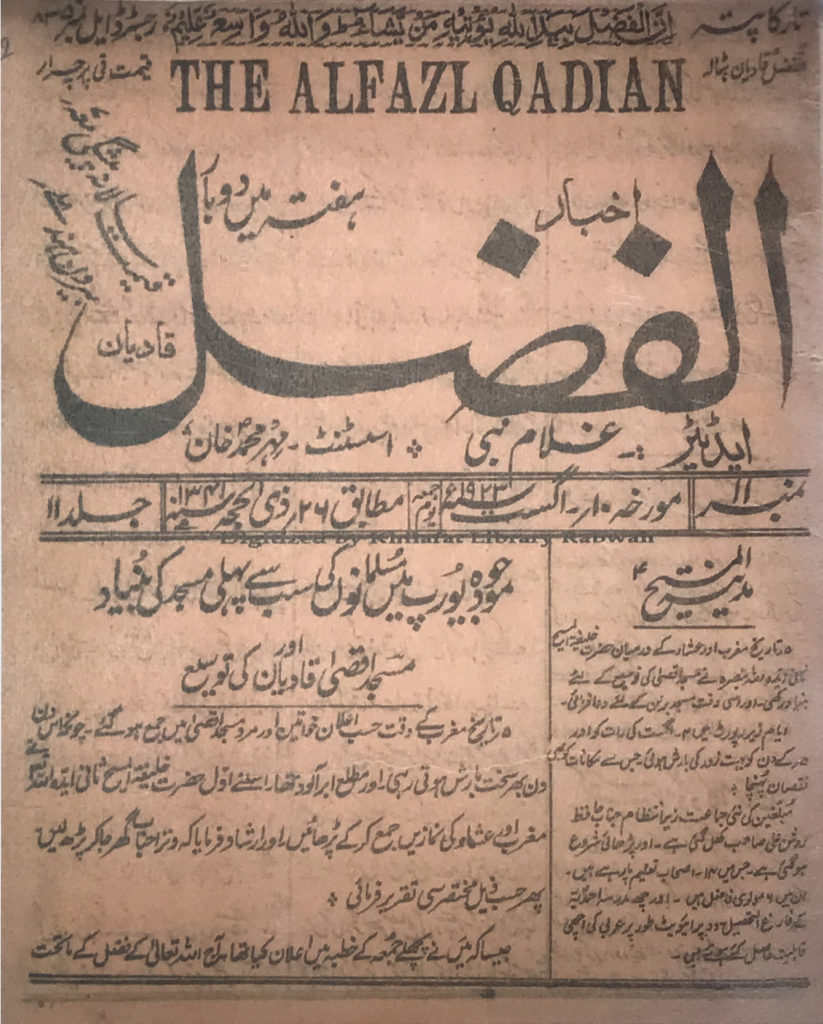
On the
fifth of this month as announced earlier, men and women gathered at Masjid Aqsa
at the time of Maghrib. Hazrat Khalifatul Masih IIra combined the
Maghrib and Isha prayers as heavy rain had poured throughout the day amidst
cloudy skies. He then instructed the worshippers to offer Witr later on in
their homes. He delivered a brief address as follows:
As I announced in the previous Friday
Sermon, the foundations for the Berlin Mosque shall, by the grace of Allah the
Almighty, be laid today. Its time, as we have come to know from the telegram,
is three o’clock in the afternoon, which, in respect to the difference of
timings, matches the current time here. Announcements regarding it have also
been made externally.
We have also gathered here to pray that
God Almighty blesses the construction of this mosque. Although a plot has
already been purchased for a mosque in London, it has not yet been built as a
mosque due to the fact that a sufficient and required sum of rupees has thus
far not been accumulated.
Hence, our very first mosque in Europe is
the Berlin Mosque. In fact, this is the first mosque built
by Muslims though three mosques have already been constructed in Europe
earlier. One is in Woking, which an Englishman had constructed, and the second
is in France, which the French government have built. There is also an old and
derelict mosque in Berlin which the government had erected too.
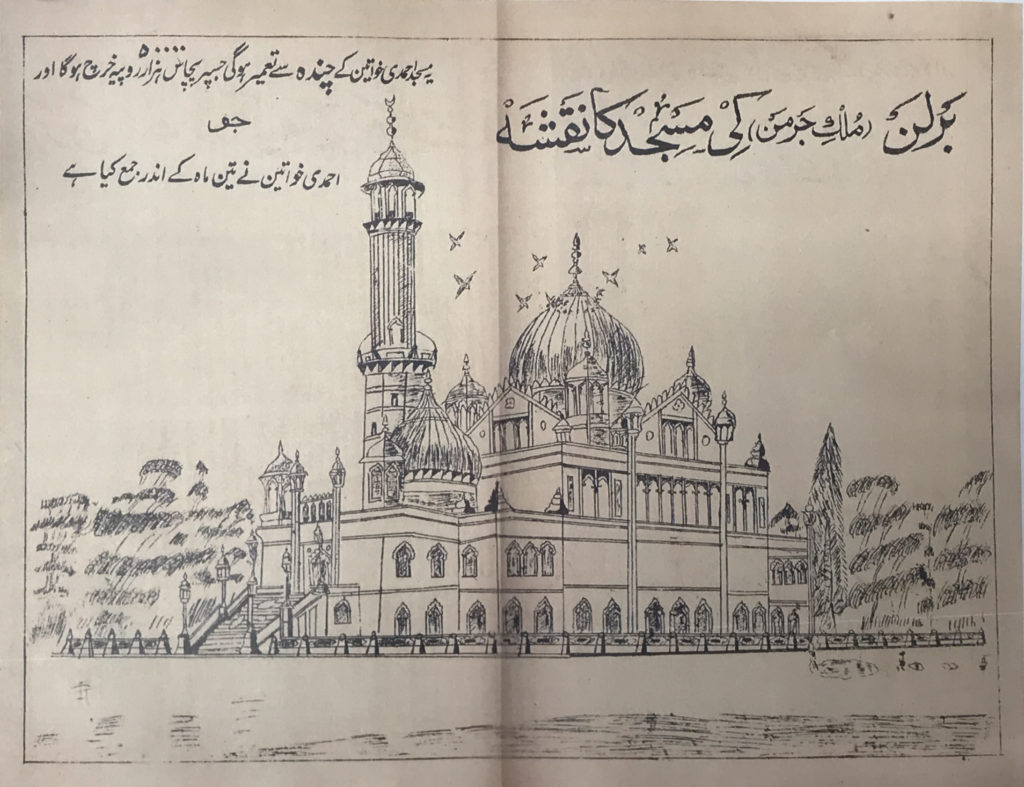
Tadib-un-Nisa, April 1923: Artist’s impression of the Berlin Mosque
When the Germans captured numerous war
prisoners from Russia, they consisted of many Muslims who numbered around
12,000 and the government had constructed that mosque for them. Hence, the very
first mosque built by Muslims in present-day Europe shall be this mosque.
I specifically mentioned “present-day
Europe” because Muslims have in fact lived in different parts of Europe for
thousands of years and built mosques in those lands. However, those mosques
disappeared when they were coerced into Christianity. To this day in Europe,
there still exist mosques in areas populated by Muslims but they are not deemed
to be part of Europe, rather they are declared to be outside its territory.
Hence,
this area, which is considered to be Europe and from where Muslims were ousted
at the time holds its very first mosque. For this reason, it is my desire for
all of us to collectively pray that God Almighty blesses this mosque and makes
it a means for the propagation and expansion of Islam.
Along with the progress of the Jamaat, the
mosque in which we are currently gathered is similarly also entitled for
expansion. For this objective, there was an old plot of land which we had
purchased. However, due to some reasons, it was not included. I have now
thought that if we use this part to offer prayers, we might as well get the one
adjacent to this new plot.
I shall initially place its foundation
stone and then return here to pray.
Afterwards, Huzoorra headed downstairs with a few companions, descending the staircase of the mosque’s southern flank. He placed seven bricks with his hands into the eastern corner of the present mosque. Then, he went back to the mosque and led a lengthy supplication in which both men and ladies participated.
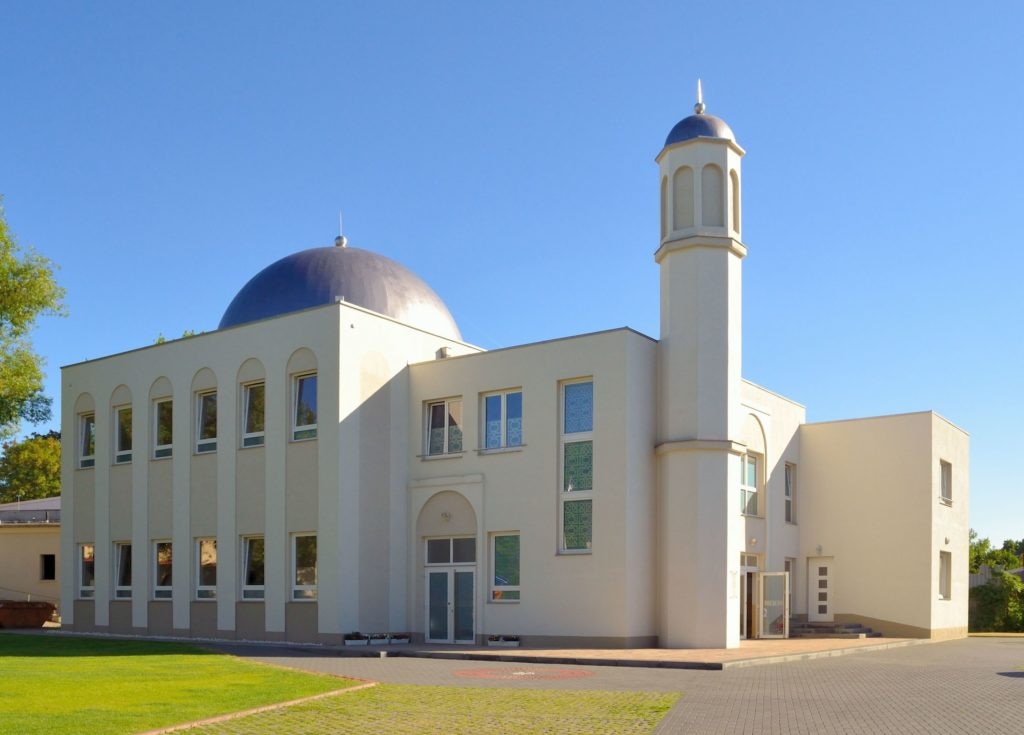
Khadija Mosque Berlin, Germany
(This mosque could not see completion and was built in the time of
Hazrat Amirul Momineen, Khalifatul Masih Vaa and was formally
inaugurated in 2008.)
Alhamdolillah, the
foundation stone for the mosque has been laid. I had a general idea of its
occurrence, but I interpreted it according to what you wrote; that the timings
were not given in the initial telegram and were mentioned in the second.
Maulvi Mubarak Ali Sahib
When I heard that the Egyptian national
delegation opposed this development when they came to know of it, I was
astonished. What do they know about us?
I hope that you will have refuted their opposition.
At present, I do not have enough time, but
next week, I shall write an article about it and dispatch it from here, in which
the notion that we are the “agents” of the British shall be properly refuted.
I was surprised to hear of the objection
regarding “Khalifatul Masih”. The word “masih” [messiah] is not as
commonly used amongst the Christians as is “Yasu” [Jesus]. “Masih”
is a status rather than a name. This word is used both in Arabic and Hebrew and
its meaning is “mamsuh”, i.e. whom God has blessed and placed His hands
upon. Thus, what relation does it have with the Christians? Further, is the
word “Khalifa” not enough to demonstrate that the word refers to the
forthcoming Messiah who would be a Muslim? If we accept this objection that
these people raise, we should also remain prepared, in future, when they object
as to why Hazrat Mirza Ghulam Ahmadas is called “Masih-e-Maud”. What
connection does this have to Christianity?
If it is not objectionable to call Hazrat
Mirza Ghulam Ahmad the “Masih”, then why is it objectionable to brand his
successor Khalifatul “Masih”? Thus, altering the words “Khalifatul Masih” would
be tantamount to showing that we are prepared to forsake the words
“Masih-e-Maud” for Hazrat Mirza Ghulam Ahmadas.
God Almighty has bestowed the name “Masih”
upon the Imam of this age. Hence, his successor will be Khalifatul Masih. Those
who fathom spiritual insights can understand that this word is not parallel to
that of the Christians but is, on the contrary, a powerful weapon to shatter
the false doctrines of Christianity.
I have come to understand from what you
have written regarding politics that you have neither understood the manner in
which the Jamaat is run, nor are you well versed in politics yourself. As a
result, you cannot satisfactorily reply to those who raise allegations. On no
account do we claim that every Englishman ought to be supported, nor do we
claim that the British government is perfect. The crux of what we say, rather,
is that subjects of every country should respect their country’s laws and also
that India benefitted to a great degree by the arrival of the English
government. Since India has accepted the British government as rulers, offices
can be taken by coming to a compromise with them in accordance with
international law and a code of conduct.
Freedom is undoubtedly an admirable thing.
However, are the Germans prepared to separate from the Rhine and Bavaria
through a palisade? Was the war of Southern America lawful? Thinkers in Europe
name it a struggle for freedom. If it was not, then why? Are the Germans now
ready to make Hamburg and Berlin independent or have those who make tall claims
of freedom deemed such struggles for these cities lawful? Or do they currently
think it lawful?
A principle should initially be
established and then, all matters ought to be decided based on that principle.
It should not be that there be a different law for others and another for
yourselves.
“God Almighty desires to draw all those
who live in various habitations of the world, be it Europe or Asia, and who
have virtuous nature, to the Unity of God and unite His servants under one
Faith. This indeed is the purpose of God for which I have been sent to the
world.” (The Will, pp. 8-9)
It is stated in Tarikh-e-Ahmadiyyat:
“Acting in accordance with Divine
instructions, the Promised Messiahas made special arrangements to
promulgate this message [of reformation and revelations] across the globe.
Hence, the Promised Messiahas published a total of 20,000
announcements in Urdu and English and dispatched them through registered
couriers to all the famous religious leaders, rulers, great emperors, scholars,
intellectuals, judges and noblemen of Asia, Europe and America. There was not a
single noteworthy personality left in that age whom he had not conveyed this
message of God to.” (Tarikh-e-Ahmadiyyat, Vol. 1, pp. 253-254)
Hazrat Mirza Bashiruddin Mahmud Ahmad,
Musleh-e-Maud, Khalifatul Masih IIra, states:
“It is incumbent upon us to caution the
world about their mistakes and to take advantage of every opportunity for the
tabligh of Islam as much as possible. After this war [World War II], at least
two countries must be convinced to consider our message with seriousness and
sincerity, i.e. Germany and Japan. These two countries are such that they would
be inclined to hear our message.
“Specifically, Germany is a type of country
which stands out in this regard. We will reach out to these people and draw
their attention to understand the fact of how greatly Christianity has failed
and that regardless of being slaves to Christianity for almost 2,000 years,
they have still remained slaves, the example of which is nowhere to be found
except for the ancient times. Thereupon, their hearts shall incline towards
Islam and they shall be of the opinion that they should leave Christianity and
begin to ponder over Islam and observe as to what remedy it suggests for their
sorrows.
“Thus, that time is fast approaching when
we will have to present clearly the failure of Christianity and the supremacy
of Islamic teachings before German and Japanese nations, both. In the same
manner, we will be able to indicate the eminence of every principle of Islam
before the intelligentsia of England, America and Russia.
“However, this is only possible when our
strength is organised, when members of our Jamaat are ready to make sacrifices
in abundance, when we have missionaries in large numbers and when we possess
all that is required for these missionaries. Likewise, this task is only
possible when all the youngsters of our Jamaat are well organised and not one
individual is left who is out of that system. In order to establish Islam and
Ahmadiyyat, each one of them should engage day and night obsessively, removing
their focus from everything and engage in this task.” (Mash‘al-e-Rah,
Vol. 1, pp. 377-378)
“Hazrat Musleh-e-Maudra was
invited by the local Jamaat of Hamburg, Germany during his tour of Europe [in
1955]. He stated on the occasion that the German nation held a dignified
character and they had rebuilt the city of Hamburg in a short period of time.
Huzoorra said that the German nation, with its lively spirit, would
rapidly accept Islam which itself encourages to elevate the spirit. Huzoorra
said that he was the follower of that Prophetsa who made great
efforts to establish peace and harmony across the globe and being triumphant,
showed remarkable forgiveness towards his enemies who had left no stone
unturned after they put the Muslims to sword.” (Tarikh-e-Ahmadiyyat,
Vol. 17, pp. 532-533)
Mission house in Germany
Regarding
the establishment of a mission house in Germany, it stated in Tarikh-e-Ahmadiyyat:
“At the end of this year [1923], owing to
the efforts of Maulvi Mubarak Ali Sahib BA (Bengali) and Malik Ghulam Farid
Sahib MA, the second Islamic mission in Europe has been established in Germany.
Maulvi Mubarak Ali Sahib, who was carrying out tabligh in London since 1920,
was sent to Berlin and Malik Ghulam Farid Sahib MA was sent from Qadian by
Hazrat Khalifatul Masih IIra on 26 November 1923, reaching Berlin on
18 December 1923 at 10 o’clock in the morning.
“Renowned authors of Germany, Professor Fernsehe LLDand Dr Uska inclined towards Ahmadiyyat and following them, the college professors and students in Berlin were also inclined towards the quest of researching about the Jamaat. The aim of Hazrat Khalifatul Masih IIra was to establish there a significant hub of Islam. Therefore, he encouraged [the members of Jamaat] to build the Berlin Mosque, but the [econmic and political] situation of Germany suddenly took a turn for the worst. Paper currency was practically terminated and gold coins were introduced which caused prices to soar three hundred times. On one side, the expenses of a missionary rose up to 25 pounds from 6 pounds, while on the other hand, the expenses for building the Berlin Mosque were indicated to have reached 1.5 million rupees, which were previously estimated to be 30,000 rupees.
“Owing to the given circumstances, Hazrat Khalifatul Masih IIra postponed the construction of the mosque and decided that instead of dividing the strength by establishing two marakiz [sing. markaz] in Europe, they should strengthen the mission house of London and the tabligh of Islam in central Europe should be carried out from there. This decision was taken in March 1924 and in May 1924, this [Berlin mission house] was closed and Malik Ghulam Farid Sahib MA, missionary to Germany, moved to the UK. Ultimately, this [mission house] was reestablished after quarter of a century through Chaudhry Abdul Latif BA in 1949.” (Tarikh-e-Ahmadiyyat, Vol. 4, pp. 411-412)
Reestablishment
of German mission
“The
German mission was reinitiated through the hands of a life devotee, Chaudhry
Abdul Latif BA on 20 January 1949, which was previously established through
Maulvi Mubarak Ali Sahib Bengali and Malik Ghulam Farid Sahib MA in 1923,
beforing being closed down in 1924.
“Chaudhry Sahib established the
[Ahmadiyya] Markaz of tabligh in Hamburg. Initially, he began to learn German
for a period of time and meanwhile, sufficed with English. He conducted the
first gathering of tabligh in the large hall of the state building (Debnicke),
situated in the city centre. He also delivered lectures arranged by the
Universal League and Hamburg Study Club. In addition to the lectures, Chaudhry
Sahib focused on writing and published the German translation of Hazrat
Musleh-e-Maud’sra book, The Life and Teachings of Prophet
Muhammad from Zurich. This was the first book of the Ahmadiyya Jamaat which
was published in that era of the mission.
“Several Germans have accepted Islam
through the efforts of Switzerland’s mission. Abdul Karim Dunter showed
exceptional passion from among them and became the right hand of Germany’s
missionary. Mr Hans Dunger and Mr E Nowak embraced
Ahmadiyyat on 18 October and 25 November [1949] respectively and they were
given the Islamic names Abdul Hameed and Abdul Rahim. In this way, a small
Jamaat began to form in the very first year.”
Accommodation difficulties for the missionary
of Islam
“In the
beginning, Chaudhry Sahib lived in the house of a new convert, Mr Kohne, but
that person parted from the Jamaat and made it difficult for Chaudhry Sahib to
continue living in the country. Following the defeat in the World War, Germany was
experiencing tough circumstances in those days and the availability of a
residential property seemed impossible. In spite of all this, Allah the
Almighty came to our aid and help in such a sublime manner that the government
of Germany itself accepted the residential rights of the missionary of Islam in
Hamburg and arranged for a residential house for him.”
Establishment of Ahmadiyya Jamaat in
Nuremburg
“Thus
far, Ahmadiyyat had been established in Hamburg but its spread reached
Nuremburg in 1952. By the grace and blessings of Allah, a new Jamaat comprising
of three individuals was established over there. Thereafter, a new German
convert, Omar Hoffer was appointed there as an honourary missionary who
continued to serve with extreme devotion till the year 1968.” (Tarikh-e-Ahmadiyyat,
Vol. 13, pp. 137-138)
Publication of German translation of the
Holy Quran
“In the
beginning of 1954, when the Ahmadiyya Muslim Mission of Switzerland published
the German translation of the Holy Quran, it was published in Germany as well.
This translation produced a huge impact on the intellectual class of that
country. It was greatly acknowledged by the German press while German journals
and magazines wrote exquisite reviews on it. Two editions of this translation
have been published.” (Tarikh-e-Ahmadiyyat, Vol. 13, p. 150)
Der Islam
magazine
“Although the German [magazine], the monthly Der Islam, began to publish in 1948 [this should 1949 – Editor] from the Switzerland mission, the task of its
publication was handed over to the German mission in 1962 and it began to
publish from Hamburg. In the year 1970, when the Markaz of German missions was shifted
from Hamburg to Frankfurt, Der Islam magazine began to publish from
Frankfurt as well.” (Tarikh-e-Ahmadiyyat, Vol. 13, pp. 151-153)
Hazrat Khalifatul Masih IIIrh
in Germany
“The
primary foundation of Islam’s spiritual revolution in Germany had been laid by
the blessed hands of Hazrat Musleh-e-Maudra. In order to make that
foundation stronger and larger than before, the promised grandson of the
blessed Mahdi, Hazrat Mirza Nasir Ahmad, Khalifatul Masih IIIrh went
to Germany during his famous tour of Europe in 1967. Hazrat Khalifatul Masih
IIIrh stayed in Frankfurt from 8 to 10 July.
“A huge welcome ceremony was arranged in
Huzoor’srh honour by the Germany Jamaat on 9 July. Apart from
devoted Ahmadis of Germany, the [ceremony] had the participation of various
esteemed personalities of the city, i.e. clergymen, lawyers and professors.
“On that occasion, Missionary In-charge, Chaudhry Abdul Latif Sahib read out the welcoming words, in response to which Huzoorrh delivered an impressive address in English. In that [address], Huzoorrh gave a wonderful message to the Germans saying,
‘Allah the Almighty has sent His promised one for the help and assistance of
Islam as the reformer, Promised Messiah and Mahdi of this age. He challenged
the world that God Almighty has manifested countless signs on his hand in the
capacity of the Holy Prophet’ssa noble son and if anyone from among
the Christians could prove that the miracles of Jesusas were greater
in superiority and magnitude than his miracles, then he would be ready to
present a mighty reward for him.’
“Carrying on with the subject, Huzoorrh
stated, ‘In the capacity of the third Khalifa of the Promised Messiahas,
I repeat the same challenge and we will be extremely delighted if the leaders
of other religions accept my challenge because in that way, the world shall
witness a manifest sign of the truth of Islam and the founder of the Ahmadiyya
Jamaat.’
“At the end, Huzoorrh said, ‘I
solemnly claim that the God of Islam is a living God and the Holy Prophetsa
is a living prophet [in spirit] and the Promised Messiahas is his
noble son.’” (Tarikh-e-Ahmadiyyat, Vol. 13, pp. 154-155)
“When Hazrat Khalifatul Masih IIIrh
was in Frankfurt, he expressed his dream from the past, bearing glad tidings
about the German nation that there was a place where Hitler was present as well
and he said to Huzoorrh, ‘Come with me so that I may show you my
museum.’ Hence, he escorted Huzoorrh to a room which had a collection
of various things. A stone was placed at the centre of the room which
looked like a betel leaf. That stone bore the inscription of äîÇ Çðäٰçî ÇðäñîÇ Çääñٰç [There is none worthy of worship accept Allah]. Huzoorrh
interpreted the dream to mean that though the German nation appears to be
hard-hearted at first or outwardly away from religion, but their hearts possess
the ability to accept Islam.” (Tarikh-e-Ahmadiyyat, Vol. 13, p. 155)
Mission
and mosque in Berlin
It is
recorded in Tarikh-e-Ahmadiyyat:
“Hazrat Khalifatul Masih IIra
had been making great efforts to build a mosque in Germany for a period of
time. Finally, Maulvi Mubarak Ali Sahib was sent to Berlin from London in
September 1922. He managed to obtain a piece of land under the guidance of
Huzoorra. Thereafter, Huzoorra launched an appeal on 2
February 1923 that the Berlin Mosque should be built from the contribution of
women’s Chanda [monetary sacrifice].
“This appeal uplifted the morale of Ahmadi
women and initiated a remarkable passion of sincerity, sacrifice, devotion and
divine spirit which has no equivalent in the history of Islam. If there exists
a similar example, then that is only of the female Companions of the early
period of Islam.
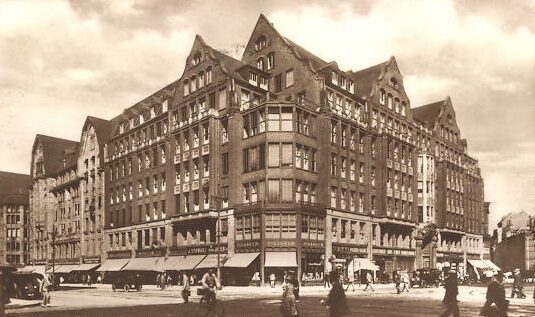
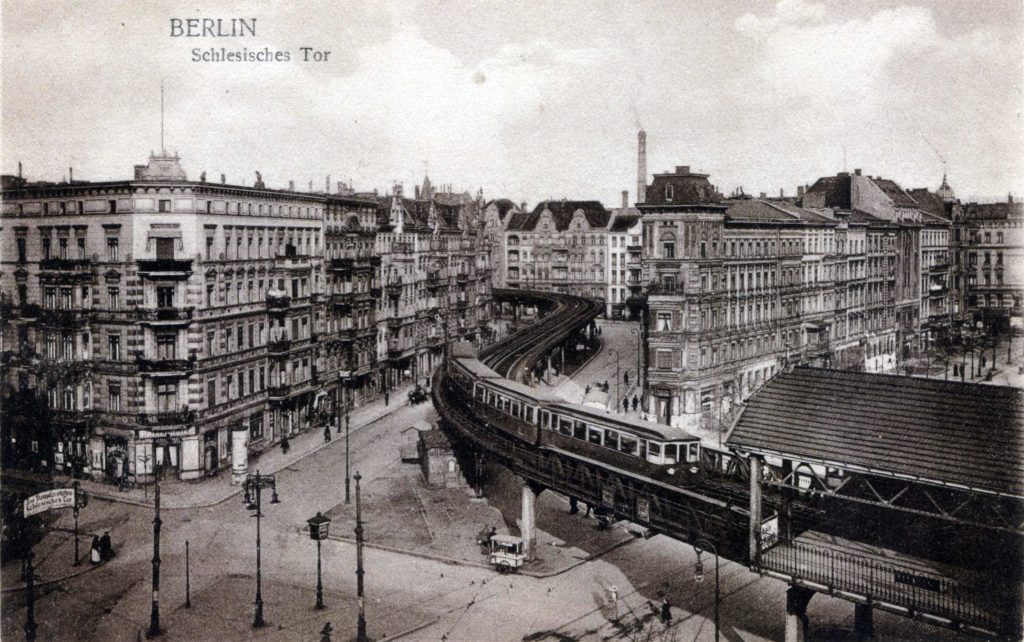
Early photo of Berlin, Germany
“Hence, Hazrat Ummul Momineen (Syeda
Nusrat Jehan Begum Sahibara) received a share of 500 rupees from a
property and she presented all of it in Chanda. Hazrat Nawab Mubaraka Begum
Sahibara presented 1,000 rupees. Hazrat Nawab Amatul Hafeez Begum
Sahibara, the wife of Sahibzada Mirza Sharif Ahmad Sahibra,
Hazrat Umme Daud (wife of Hazrat Mir Muhammad Ishaq Sahibra) and the
wife of Khan Bahadur Hazrat Sahibzada Mirza Sultan Ahmad contributed to the
cause to a great extent. The immediate family of Hazrat Khalifatul Masih IIra
did not fall behind in [monetary] sacrifices from other blessed female family
members of the Promised Messiahas. Hazrat Umme Nasirra
received a sum of money from Huzoorra, half of which she presented
for Wasiyyatand the rest, in this cause. Hazrat Amatul Haye Sahiba
presented 100 rupees. Hazrat Umme Tahirra presented one of her
necklaces and some money.
“Among other women of Qadian, the family
members of Hazrat Sheikh Yaqub Ali Irfani Sahibra, Hazrat Qazi Amir
Hussein Sahibra and Hamidah Begum Sahiba (daughter of Hazrat Pir
Manzur Muhammad Sahibra) took special part in contribution. A very
poor and feeble pathan widow who was an immigrant and used walk with great
difficulty with the help of a stick came on foot and presented two rupees
before Huzoorra. This woman was poverty-stricken. She had a handful
of hens and she used fulfill some of her necessities by selling eggs while the
rest of her expenses were managed through the aid of the [Jamaat’s] system. A
Punjabi widow who had nothing except for jewellery, presented one of her
jewellery sets for the mosque. Another widow who was fostering a number of
orphans and had nothing to present from jewellery or wealth gave her utensils
of everyday use. One of the ladies presented her jewellery for the cause and
went back in order to present some utensils as well. Her husband said that she
had already presented jewellery to which she responded that she was
experiencing such a passion that if there arose a need for the religion of God
and His prophet, she would sell him and present him for the cause [only if it
was possible and permitted].
“Though these words were not at all worthy
of praise either ethically or by the Shariah (divine law), but one can surely
assess the passion which made an illiterate lady show an extreme spirit of
devotion in this manner. The wife of a brother from Bhagalpur reached Al-Dar(Qadian) with two goats and said that there was nothing in their home
except themselves and only the two goats were present, so they should be
accepted.
“The ladies outside of Qadian showed
highly inspiring and prideworthy examples as well. The wife of Captain Abdul
Karim Sahib (Ex-Commander in Chief of Khairpur State) presented all of her
jewellery and precious fabric in Chanda. Similar examples were displayed by the
female family members of Chaudhry Muhammad Hussein Sahib Sadr Revenue Official
of Sialkot, Seith Ibrahim Sahib, Khan Bahadur Khan Sahib Assistant Political
Officer of Chakdarra (Bannu), Hazrat Maulvi Abdullah Sahib Sanaurira,
Dr Azam Ali Sahib Jalandhari, Khan Bahadur Sahib Khan Nun Extra Assistant
Commissioner, Hazrat Dr Qazi Karam Ilahi Sahib Amir Jamaat Amritsar (father of
Muhammad Aslam Sahib) and Mian Muhammad Din Sahib Revenue Accountant.
“Unfortunately,
due to the unstable political situation of Germany and certain other inevitable
impediments, the construction work of the mosque had to be stopped. However,
the sacrifices of Ahmadi ladies were not wasted and a mosque was built in
London thorough their Chanda, which is the first mosque of Jamaat-e-Ahmadiyya
in Europe.” (Tarikh-e-Ahmadiyyat, Vol. 4, pp. 398-400)
Hazrat Musleh-e-Maudra states:
“The condition was such in the year 1920
that when I announced that we would build a mosque in Berlin and 100,000 rupees
were needed for it, the ladies of the Jamaat collected that amount in a matter
of a month. They removed their jewellery and presented it to collect the money
by selling them.
“Today when I mentioned that incident in
the ladies’ gathering, one of my wives told me that she was unmindful at that
time as she was still a child and she was unaware of the Jamaat’s requirements,
but her mother used to say that when Huzoorra appealed for Chanda,
her mother-in-law (who was Syed Waliullah Shah Sahib’s mother and my
mother-in-law as well) gathered her daughters and daughters-in-law, and said,
‘Each one of you should place your jewellery here.’ Thereafter, she sold that
jewellery and presented Chanda for the Berlin Mosque.
“These instances were not rare in the
Jamaat but in fact there were hundreds of households in which ladies removed
the jewellery of their daughters and daughters-in-law, and selling them,
presented [the money] for the Berlin Mosque. Hence, 100,000 rupees were
collected within a month.
“… Now, I have appealed for the Hamburg
Mosque that members of the Jamaat should present 150 rupees each. However, if
Allah the Almighty grants us wealth, then the practice of our Jamaat should be
such that each individual should build a mosque independently. I myself
contemplate that if God Almighty grants me [financial] ease, then I may build a
mosque on my own. It is not impossible that God Almighty grants me that
strength within my lifetime and I am able to build a mosque in any one of the
European countries.” (Mash‘al-e-Rah, Vol. 1, pp. 773-775)
Construction and inauguration of a mosque
in Hamburg
Hamburg, 1920
During
his stay in Hamburg on 26 June 1955, Hazrat Musleh-e-Maudra had
instructed to build a mosque in Germany without delay. Hence, God Almighty
fulfilled Huzoor’sra blessed wish within two years. The foundation
stone of the Hamburg Mosque was laid on 22 February 1957 and Hazrat Chaudhry
Zafarullah Khan Sahibra inaugurated it on 22 June 1957 and read out
the following message of Huzoorra on the occasion in English:
“Brothers of Germany! Assalamo Alaikum
wa Rahmatullahe wa Barakatohu.
“I am
sending my son, Mirza Mubarak Ahmad, to participate in the inaugural ceremony
of the Hamburg Mosque. Although the inaugural ceremony will be carried out by
Chaudhry Muhammad Zafrulla Khan Sahib Insha-Allah, but Mirza Mubarak Ahmad will
participate as my representative. With Allah the Almighty’s help, my aim is to
inaugurate a series of mosques in various other cities of Germany as well.
Hopefully, Mirza Mubarak Ahmad meeting with Maulvi Abdul Latif Sahib will
surely bring about schemes so that mosques can be built right away.
“May God enable the German nation to
accept Islam at the earliest. According to its inner abilities, just as it is
the leader of the material world in Europe, may it emerge as a spiritual leader
as well. Thus far, it is true that a German new convert is carrying out tabligh
in America after devoting his life. However, I am not satisfied by one
missionary and dozens of new converts, in fact I desire that countless missionaries
are produced from Germany and millions of German natives accept Islam so that
Europe’s leadership in the task of promulgating Islam rests in the hands of the
German nation. O Allah, accept our prayer.
“Humbly yours, Mirza Mahmud Ahmad,
Khalifatul Masih II.” (Tarikh-e-Ahmadiyyat, Vol. 4, p. 148)
After the completion of the Ahmadiyya
Jamaat’s mosque in Hamburg, the reviews by the press of that time can be read
in various newspapers from that time.
A religious newspaper The Church,
expressed in the following way:
“Hamburg has become the centre for the
holy war between Christianity and Islam. It rests upon us as to how we can
encounter the dangers attached with the building of a mosque.
“The missionary of the Ahmadiyya Jamaat
for Germany, Mr Abdul Latif came to Hamburg in 1949 and the building of a
mosque in 1957 points out his successful efforts.” (Tarikh-e-Ahmadiyyat,
Vol. 13, p. 150)
A correspondent of Bilefield
newspaper wrote under the heading, “Mosques in our country”:
“I was totally surprised when I was told
during my stay in Hamburg that a mosque has been built in Hamburg. After
further research, I was even more amazed to learn the fact that apart from the
Hamburg Mosque, the Ahmadiyya Jamaat intends to build mosques on a step-by-step
basis at various other famous places of Germany.” (Tarikh-e-Ahmadiyyat,
Vol. 13, p. 150)
Construction and inauguration of Frankfurt
mosque
“Less
than two years had passed over the inauguration of the Hamburg Mosque when
Allah the Almighty granted the German mission the strength to build another
mosque. Chaudhry Muhammad Zafrulla Khan Sahib came from Holland for it.
“Nearly 40 newspapers of Germany published
the photographs of the mosque and several scenes of the inaugural proceedings.
Moreover, they gave remarkable reviews over the tabligh efforts of the
Ahmadiyya Jamaat. For instance, the newspaper Mannheim Morgen on 15
September 1959 gave the photograph of the mosque’s inaugural ceremony and
stated under the heading “Islam is heading towards Europe”:
“The followers of Muhammad[sa] came
to the south of France with the help of swords and spears in the past. This
task is being carried out with the help of spiritual weapons in the present
age. A number of individuals of Islamic countries come to Europe and at the
same time try to spread Islam. Likewise, various proselytising sects,
particularly that of Mirza Ghulam Ahmad [Sahib] of Qadian established in the
year 1890 [sic.] in Punjab, has built mosques at various places.” (Tarikh-e-Ahmadiyyat,
Vol. 13, pp. 151-153)
Hazrat Musleh-e-Maudra stated:
“Thus, it is my desire that the mosque in
Germany is built by the Chanda of women because people in Europe think that we
treat women as animals. When the people of Europe realise that at the present
time in this city which is becoming the centre of the world, Muslim women have
prepared a mosque for the new converts of Germany, then the people of Europe
will be regretful and surprised at their viewpoint which they hold about Muslim
women. They would be awe-stricken when walking past the mosque and the mosque
would call out aloud that those clergymen tell lies who say that there is no
status for women in Islam. Such people are of the view that women are animals
in our country and they are considered and believed as such; as though we think
that Muslim women are mere animals. After a mosque is built there by the Chanda
of women, then they will know that our women are also aware of the fact that
the world possesses the kind of people who worship a mere human being [i.e.
Jesusas].
“Generally, they [Europeans] have this
custom that the husband and wife clash with each other a month after their
marriage and the husband roams about in search of another mate while the wife
too wanders in search of another partner. People there are surprised to see a
husband and wife happily living together with love; the true relationship which
is present between the husband and wife in our society is rarely present in
them but the situation is such that the pen is in the hand of an enemy. As the
pen is in their hands, therefore they write against Islam and Muslims as they
will.
“Maulvi Mubarak Ali Sahib has sent a
letter in which he has stated that an expert architect gave an estimate of
250,000 rupees for the construction of a mosque because he thought that the
group of people who had decided to build a mosque in their country would have
been extremely wealthy, but then Maulvi Sahib told him that we did not possess
that amount of money. Thereupon, he gave an estimate of 50,000 rupees, i.e.
5,000 rupees for the land and 45,000 rupees for the building.
“As he points out that it is a big city
and a city of affluent people, therefore a great building is required which can
cause an impact on people so that they are attracted towards it. An ordinary
building would not make an impact on people as it would be like a house.
Moreover, if it contains a part built by raw bricks, it would seem
inappropriate. Nevertheless, according to his estimate, the mosque can be
constructed in 50,000 rupees which would not only be a mosque but it would
contain a house for the accommodation of missionaries.
“I present this matter before all women of
the Jamaat. This is the age of competition. Women of foreign countries even
compete with men studying law and medicine. They do this to show that they are
parallel to men, regardless of whether they are able to practice that line of
work or not. However, they waste their lives in this, but we must take part in
a virtuous competition. Therefore, we say that this time, women should build a
mosque in Europe.
“Previously, the total of women’s Chanda
for the London Mosque was 10,000 rupees and according to the Shariah, it should
be half with respect to men because the Shariah has declared their share to be
half. Therefore, women should present 50,000 rupees Chandawithin three
months for the Ahmadiyya mosque of Berlin. It is a prophecy of the Promised
Messiahas that the scepter of the Tsar would be snatched and handed
over to him; the door to Russia is Berlin and only through that door can Russia
be won. Carrying out tabligh in Russia is still quite far as it is even
impossible to enter it in the present circumstances.
“Germans are the means to tabligh in it
and we can very easily carry out tabligh in Russia through the Germans. It will
leave a huge impact upon them when this prophecy is fulfilled through women.
Those who come after them will realise that women equally possess that passion
which is present in men. On the other hand, Europe will recognise the burning
passion of Muslim women for the promulgation of their religion and it will be
engraved on the façade of the mosque that this mosque was built by Ahmadi women
for the new converts. It will also be an eye-opener for others and Paighamis
will also understand that Ahmadi women alone present that amount of Chandawhich
the Paighamis collect by begging of other people.
“Thus, women of all places must be
informed to present Chanda for this cause and every newspaper which is
published from Qadian must appeal to give Chanda for it. Moreover, this address
of mine should be published so that those people who are associated with these
newspapers express to the women in their homes and motivate them to present
Chandafor the mosque within three months. The men of all places must
inform the women in their households about this and those men whose wives were
unable to attend the Friday prayer should inform them and help raise funds for
this cause.
“And I have entrusted this task to the
Anjuman [body] which has been named by me as Lajna Imaillah.” (Al Fazl,
8 February 1923)
Hazrat Musleh-e-Maudra in
Germany
During
his tour of Europe, Hazrat Musleh-e-Maudra reached the city of
Nuremburg, Germany from Austria on 15 June 1955. Chaudhry Abdul Latif Sahib,
Missionary of Germany and various other devoted fellows were present there to
welcome [Huzoorra] at around 6pm. There were 15 Ahmadi men and women
in Nuremburg at that time who were brimming with passion and admiration. At
this place, Huzoorra shared his views with the new converts on the
subject of tabligh in Germany.
Huzoorra went to The Hague on
17 June and stayed in Holland until 24 June.
Huzoor’s
flightlanded at Hamburg Airport on 25 June accompanied by Syeda
Umme Mateen Sahiba, Syeda Mehar Apa, Sahibzadi Amatul Jamil Sahiba, Sahibzadi
Amatul Mateen Sahiba, Sahibzada Dr Mirza Munawar Ahmad Sahib, Mir Daud Ahmad
Sahib, Sahibzada Mirza Mubarak Ahmad Sahib and his wife and Dr Hasmatullah
Sahib. (Tarikh-e-Ahmadiyyat, Vol. 13, pp. 529-535)